
Search Modeling & Forecasting
Search Engine Modeling: Simulating the Systems Behind Rankings
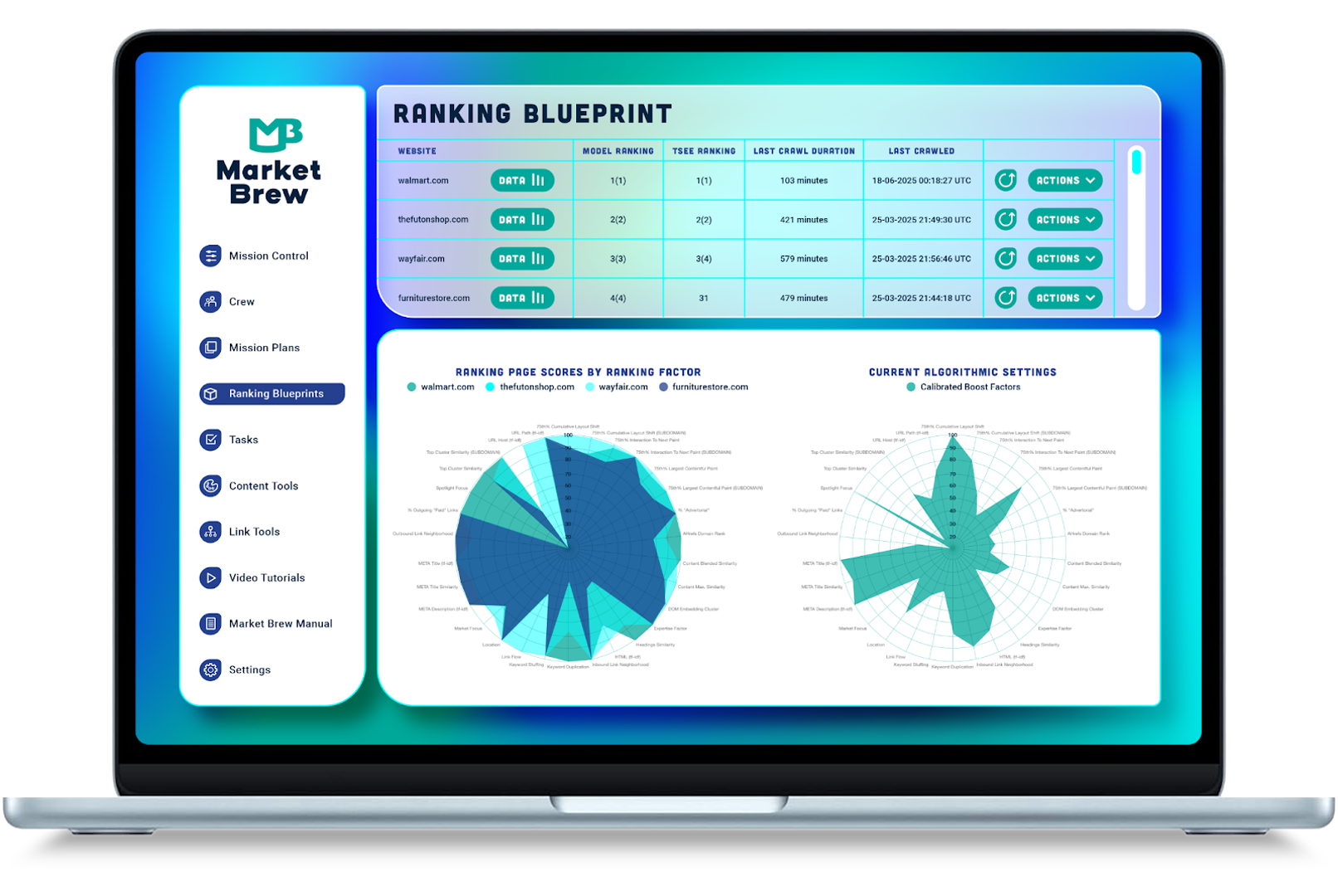
Search visibility is the output of a connected system. A page exists within a website, receives support through links, communicates meaning through content and structure, and competes against other pages within a particular search environment. Most SEO reporting separates those conditions into individual measurements.
Search engine modeling brings them back together.
By creating a simulated environment around the website, its competitors, target queries, and measurable ranking signals, SEO teams can investigate how different parts of the system interact and develop stronger explanations for why visibility is occurring.
Market Brew is built around this modeling approach, giving enterprise SEO teams a way to inspect the systems behind rankings rather than relying only on the outputs they produce.
What Is Search Engine Modeling?
Search engine modeling is the process of creating a simulated environment that represents how search systems may crawl, evaluate, score, and compare webpages.
A useful model does not assume that one ranking factor explains an outcome by itself. It represents multiple conditions within the same environment, including content relevance, authority, semantic relationships, technical conditions, site structure, page relationships, and competitive context.
Those signals can produce very different outcomes depending on how they interact.
Strong content may occupy a weak position within the website. A highly authoritative page may be poorly aligned with the topic it is expected to rank for. Shared templates or internal-linking patterns may influence entire groups of URLs rather than one page in isolation.
Search engine modeling gives teams a way to examine those conditions as parts of the same system.
A Search Model Needs More Than the Website
Understanding a page requires context from both the website and the search environment surrounding it.
Within the website, pages are connected through navigation, internal links, templates, content relationships, and site structure. Those connections help determine where authority flows, which pages receive reinforcement, and how different areas of the site relate semantically.
The competitive environment adds another layer.
Target queries, competing pages, content patterns, authority conditions, search intent, and the types of pages appearing in the results all affect how a page should be interpreted.
Page type also matters. A product page may operate under very different competitive conditions than an article, category page, location page, or other template.
A useful model therefore evaluates pages within relevant contexts rather than treating every URL and every search market as interchangeable.
This creates a more realistic environment for understanding why certain pages separate from others.
Calibration Gives Ranking Signals Context
The same measurable signals do not carry the same significance in every search environment.
Internal authority may create meaningful separation between competing pages in one market. Semantic alignment may distinguish them more clearly in another. Technical conditions, external authority, duplication, or other factors may matter more somewhere else.
Calibration helps a model evaluate those relationships within the environment being studied.
That distinction is important because the presence of a ranking signal is not the same thing as evidence that changing it will improve performance. Correlation does not always mean causation.
For example, longer content may correlate with stronger rankings in a particular result set without word count itself being the reason those pages perform better. Length could instead reflect greater topical coverage, a more complex intent, stronger expertise, or another underlying condition.
Backlinks present a similar reasoning problem. They may contribute to visibility, while greater visibility can also create additional opportunities to earn links.
Search engine modeling does not eliminate those uncertainties. It gives SEO teams a more relevant environment in which to investigate them.
What a Modeled Search Environment Makes Visible
The primary value of a search model is not any individual score.
It is the ability to examine a page from several connected perspectives at once.
Consider an ecommerce category page.
Its content can be evaluated against the semantic patterns of pages competing for the same search market. Its position within the site's internal-link structure can show how much support reaches the page and where that support originates. Its surrounding architecture can reveal how strongly the website reinforces its role. Its competitive measurements can show which factors most clearly distinguish stronger-performing pages within that particular environment.
None of those views alone explains the entire result.
Together, however, they create a richer representation of the system surrounding the page.
The page can be examined simultaneously as content, as a destination for authority, as part of a website structure, and as a competitor within a particular search environment.
That is what search engine modeling makes possible: the relationships behind search visibility become inspectable rather than existing as disconnected measurements.
From Observations to Better SEO Hypotheses
Once those relationships become visible, SEO teams can ask more precise questions.
|
Vague SEO Observation |
Precise Search Model Question |
|---|---|
|
This page is underperforming. |
Is the page receiving less internal support than competing pages within the site? |
|
These two articles are losing visibility. |
Are they occupying such similar semantic territory that the site is reinforcing the same topic through multiple URLs? |
|
This category performs well for one query group but poorly for another. |
Does the page align with the content and intent patterns of one competitive environment more strongly than the other? |
Those new precise questions are hypotheses, not conclusions.
A modeled relationship still requires interpretation. Multiple variables may interact, other explanations may exist, and an observed relationship should not automatically be treated as causal.
But the model gives teams a better place to begin investigating than an isolated ranking movement or generic ranking-factor study.
Modeling Creates an Environment for Testing Change
The same modeled environment can also provide a controlled basis for examining proposed SEO changes.
Once a team develops a credible hypothesis, it can evaluate how changing content, structure, internal relationships, authority distribution, or another modeled condition may alter the environment.
This is where search engine modeling begins to support predictive SEO.
The model provides the system in which a change can be evaluated.
The next question is different: Which proposed change is most likely to create meaningful impact, and is that impact worth the resources required to implement it?
That is the role of SEO forecasting. Forecasting builds on the modeled environment to compare alternative interventions based on expected impact, uncertainty, effort, and business value.
Market Brew's Search Modeling Approach
Market Brew was built around the idea that the systems influencing search visibility should be inspectable.
Rather than treating rankings, content, authority, structure, and competitive signals as unrelated reports, Market Brew creates modeled search environments in which those relationships can be analyzed together.
The model can be calibrated to the website, queries, competitors, and search environment being studied, helping enterprise teams investigate which signals and relationships appear most relevant within their particular market.
That modeling layer forms the technological basis for many of the analyses and predictive workflows available throughout the Market Brew platform.
The Origins of Market Brew's Search Model
Market Brew's approach grew from patented work on making search-engine-style scoring transparent and navigable.
The original Navigable Website Analysis Engine was designed so users could move through modeled website scores, webpages, ranking factors, links, and supporting details rather than receiving an unexplained result.
That foundation established an important principle that continues to shape Market Brew today:
A useful search model should not only produce a score. It should make the relationships contributing to that score possible to investigate.
See the System Behind Search Visibility
SEO teams rarely lack data. The harder problem is understanding how the pieces relate.
Market Brew models the website and its search environment as a connected system so teams can investigate the mechanisms behind visibility, develop stronger hypotheses, and create a more informed foundation for testing what to change next.
From ambiguity to actionable insight.
Decode ranking systems, surface leverage points, and deploy with clarity.