
Strong content depends on technical infrastructure that allows search systems to reliably access, process, and understand it.
A page can be well written and strategically important while still losing visibility because crawlers cannot reach it, rendering fails, indexing signals conflict, internal pathways break, or sitewide templates introduce technical problems at scale.
These foundations also matter across AI-driven search experiences. Different systems may use different crawlers, indexes, and retrieval processes, but accessible and usable information remains fundamental.
And for most SEO teams, the challenge extends beyond finding technical errors. Large audits can surface thousands of warnings. The more important task is determining which issues interfere with strategically important pages, how widely they occur, and where fixing them will create the greatest value.
Technical SEO Checklist
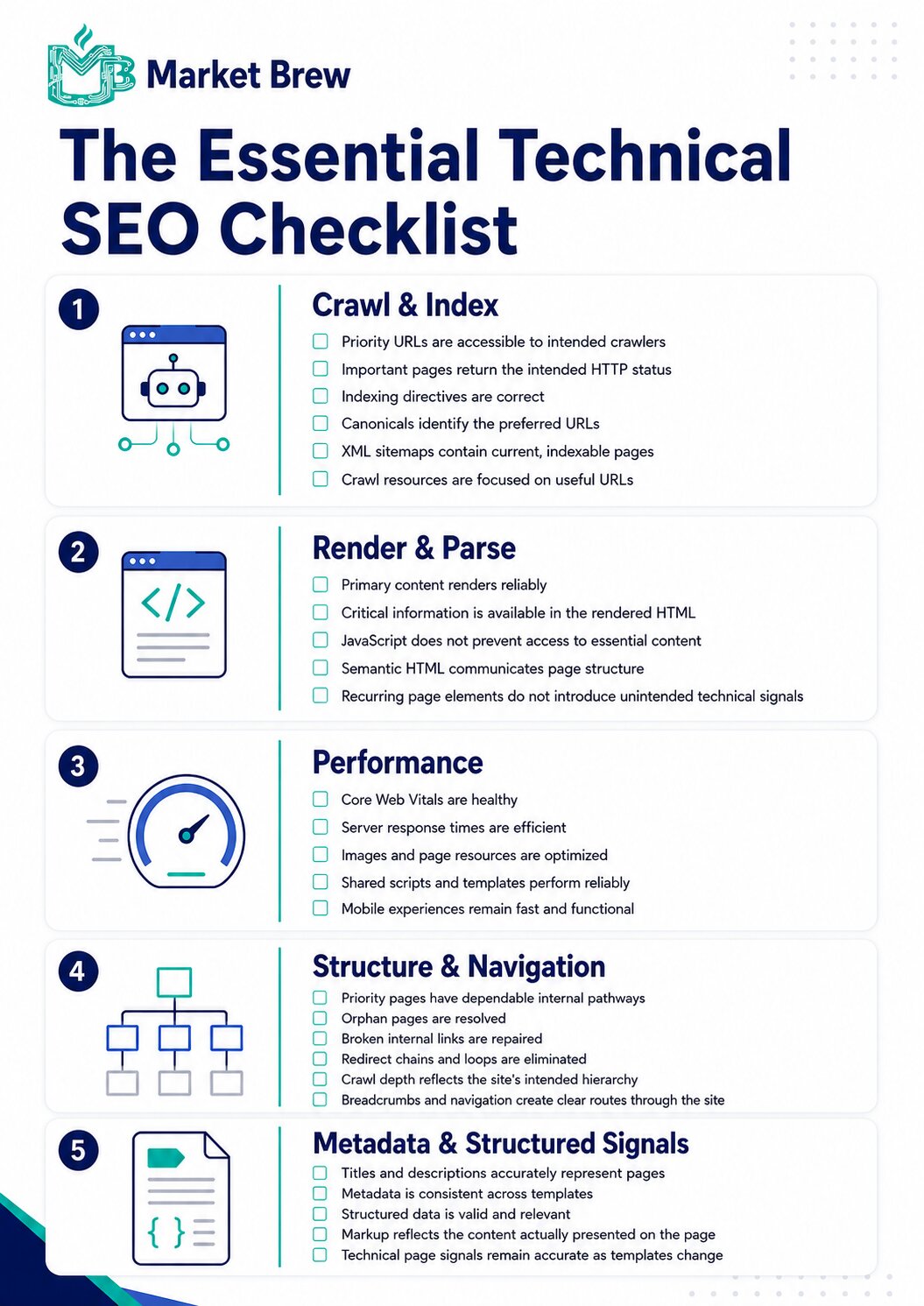
Make Important Pages Accessible and Indexable
Search visibility begins with access.
A search system needs to discover and request a URL before it can process the page and determine whether it belongs in an index.
Several technical controls affect different parts of that process, so they should be reviewed separately.
Confirm Priority URLs Are Accessible
Important indexable pages should return the intended response and be available to the crawlers expected to access them.
Audit priority URLs for:
- Server errors
- Unexpected redirects
- Authentication requirements
- Accidental crawler restrictions
- Broken or unavailable resources
- URLs that resolve differently from their intended destination
robots.txt controls which areas a compliant crawler can request. A mistake in a sitewide robots rule can therefore affect an entire section of a website at once.
Crawler access should reflect the site's actual priorities.
For a deeper explanation of discovery and crawler behavior, see our comprehensive guide on web crawlers
Set Indexing and Canonical Signals Correctly
Successful access does not automatically make a URL eligible for indexing.
Robots meta directives and the X-Robots-Tag HTTP header can provide page-level indexing instructions. Priority pages should be checked for accidental noindex rules and other directives that conflict with the intended search experience.
Crawler access and indexing controls also serve different purposes:
- robots.txt manages crawler access.
- Robots meta directives provide page-level indexing instructions.
- Canonical signals indicate the preferred representative among duplicate or highly similar URLs.
Canonicalization becomes especially important when the same content is available through multiple URL variations.
Review canonical tags alongside redirects, XML sitemaps, and internal links so the site's signals consistently reinforce the intended version.
Keep Sitemaps and Crawl Resources Focused
XML sitemaps should provide a clean inventory of the URLs the site actually wants search systems to discover and consider for indexing.
Obsolete pages, redirected URLs, duplicates, and non-indexable content create unnecessary noise.
Scale makes this more consequential.
Large websites can generate enormous numbers of parameterized URLs, filtered combinations, duplicate variants, and low-value pages. Those URL patterns can consume crawler resources and make important content harder to discover efficiently.
Our guide to Optimizing Crawl Budget for Large Websites explores those large-scale crawl considerations in greater depth.
Make Sure Search Systems Receive the Intended Page
Reaching a URL only establishes that the server responded.
The next concern is whether the content and links search systems receive accurately represent the page the SEO team intended to publish.
Modern websites frequently rely on JavaScript, responsive components, third-party scripts, and dynamic interfaces. Those systems can change what exists in the rendered HTML.
Render Critical Content Reliably
Inspect rendered pages to verify that important copy, headings, links, images, structured information, and navigation are available after processing.
JavaScript implementations deserve particular attention when critical content:
- Appears only after client-side execution
- Requires user interaction before loading
- Depends on external services
- Produces different output for different devices
- Fails when scripts time out or encounter errors
Pages that rely heavily on client-side execution introduce additional dependencies between the initial server response and the finished page.
Server-side rendering, static rendering, or other delivery approaches can provide more dependable access where JavaScript creates recurring problems.
Review the Complete Rendered Page
Enterprise templates can also introduce content that receives little attention during a normal editorial review.
Navigation variants, responsive menus, consent interfaces, related-content modules, review widgets, legal elements, and other recurring components may all appear in the rendered page.
A component repeated across thousands of URLs becomes a sitewide technical signal.
Review both what users see and what exists in the underlying rendered HTML. This can expose duplicated responsive elements, hidden links, repeated blocks, or content that behaves differently from what the visual interface suggests.
Our Semantic SEO guide explores the separate question of how rendered content can affect a page's meaning and semantic focus.
Use HTML to Communicate Structure
HTML provides a machine-readable representation of how the page is organized.
Headings, links, navigation, images, lists, and structural elements should communicate their function through appropriate markup rather than relying entirely on visual design or interaction.
HTML optimization also supports accessibility and makes important page relationships easier to process consistently.
Create Dependable Paths Through the Website
Technical SEO also determines how easily crawlers can move from one page to another.
Important pages need stable internal routes connecting them with the rest of the site.
Resolve Orphan Pages and Weak Discovery Paths
An indexable URL can still be difficult to discover when few meaningful links lead to it.
Audit for:
- Orphan pages
- Excessive crawl depth
- Important URLs accessible only through XML sitemaps
- Broken internal links
- Sections disconnected from primary navigation or relevant parent pages
Breadcrumbs, category relationships, hubs, navigation, and contextual links can all create dependable pathways through the website.
Crawl depth should also be interpreted in context. A deeply nested utility page has a different role from a commercially important product or service page buried at the same depth.
Clean Up Redirects and Broken Routes
Redirects provide useful continuity when pages move.
Over time, however, migrations, redesigns, and repeated URL changes can produce chains, loops, outdated internal references, and unnecessary hops.
Audit internal links so they point toward the intended final destination where practical.
This creates cleaner routes for users and crawlers while reducing dependence on layers of historical redirects.
Broken internal links should receive similar attention, especially when they interrupt important navigation or content journeys.
Evaluate Sitewide Navigation
Large navigation systems can reshape a website with a single template decision.
Mega menus, footers, breadcrumbs, sidebars, related links, and recurring components may create connections across thousands of pages. Small decisions can have outsized impacts on your sitewide link flow.
Technical SEO should evaluate whether those structures create reliable discovery paths and whether unnecessary complexity is being repeated across the site.
Keep the Experience Fast and Functional
Technical accessibility includes the quality and reliability of the experience delivered after a page loads.
Performance problems can affect users directly and become especially consequential when they originate in shared templates or components.
Monitor Core Web Vitals
Core Web Vitals provide useful measurements of loading performance, responsiveness, and visual stability:
- Largest Contentful Paint (LCP) measures loading performance.
- Interaction to Next Paint (INP) measures responsiveness.
- Cumulative Layout Shift (CLS) measures visual stability.
The metrics are most useful when they lead to the technical systems causing the problem.
Poor results may trace back to:
- Slow server response
- Render-blocking resources
- Large or poorly delivered images
- Third-party scripts
- Excessive JavaScript
- Layout behavior
- Recurring template components
Look for Performance Problems at Scale
An inefficient script affecting one low-value page is contained. But when the same script is running across hundreds of thousands of pages, it becomes a much larger technical issue.
Evaluate:
- Shared JavaScript and CSS
- Image-delivery systems
- Caching
- Third-party tags
- Server behavior
- Template components
- Mobile-specific resources and interactions
This template-level view helps identify changes capable of improving large groups of pages at once.
Keep Technical Page Signals Accurate
Pages also contain explicit technical information about how they should be represented and understood.
These signals need to remain accurate as content and templates evolve.
Meta Titles and Metadata Should be Consistent
Page titles and meta descriptions should accurately represent the content they belong to.
Larger websites frequently generate metadata through templates, making pattern-level problems especially important.
Audit for:
- Missing titles
- Duplicate or boilerplate titles
- Metadata referring to outdated products or categories
- Template variables failing to populate
- Descriptions mismatched with page content
Metadata cleanup becomes much more valuable when it corrects a recurring pattern across an important section than when it addresses isolated low-value URLs.
Validate Structured Data
Structured data provides explicit machine-readable information about entities and content represented on a page.
Review markup to confirm that it:
- Uses an appropriate schema type
- Accurately reflects the page content
- Includes the required properties
- Remains valid when templates change
- Passes relevant validation
- Stays consistent with the information presented to users
Structured data and schema markup should be evaluated at the template level whenever the same markup appears across large groups of pages.
Prioritize Technical SEO by Impact, Scale, and Page Value
Technical audits can surface thousands of findings.
Prioritization becomes much more useful when every issue is evaluated across three dimensions.
Impact
Determine how severely the issue interferes with the website.
A problem may affect:
- Crawler access
- Rendering
- Indexability
- Internal discovery
- Page performance
- Technical page signals
An unintended noindex directive can completely remove a page from search consideration. A slightly imperfect meta description has much less impact on your ability to rank or be recommended.
Scale
Determine how widely the problem occurs.
A finding may affect:
- One URL
- A small page group
- One template
- A major site section
- Most of the website
Template-level issues can turn minor technical mistakes into significant enterprise problems.
A duplicated component on one URL may deserve little attention. The same component rendered across 500,000 pages can become a priority.
Page Value
Consider the strategic importance of the affected pages.
A severe problem on a low-value archive carries different consequences from the same problem on a primary product category, lead-generation page, or high-performing resource.
Page value can reflect:
- Organic traffic
- Revenue
- Conversions
- Strategic product importance
- Content importance
- Search demand
- Business priority
These three dimensions give teams a more useful way to sequence technical work.
Turn a Technical Audit Into a Prioritized Plan
A large technical SEO audit may reveal thousands of individual problems across pages, templates, navigation systems, and site sections. Teams then need to understand which findings connect to important visibility problems and which can reasonably wait.
Market Brew helps place technical findings within the wider website and search environment.
By modeling the site as a connected system, teams can evaluate technical problems alongside the pages, internal relationships, authority signals, and search outcomes they may influence. This provides additional context for identifying issues affecting strategically important parts of the website.
Market Brew's broader search engine modeling approach can also help teams understand how technical changes interact with other visibility signals, while SEO forecasting provides a framework for comparing potential interventions before implementation resources are committed.
Technical SEO creates the infrastructure that gives content a reliable path into search and AI systems.
A strong program keeps that infrastructure accessible, renderable, navigable, fast, accurate, and aligned with the pages the organization values most.
From ambiguity to actionable insight.
Decode ranking systems, surface leverage points, and deploy with clarity.