
Search Modeling & Forecasting
SEO Forecasting: Compare Expected Impact Before You Invest
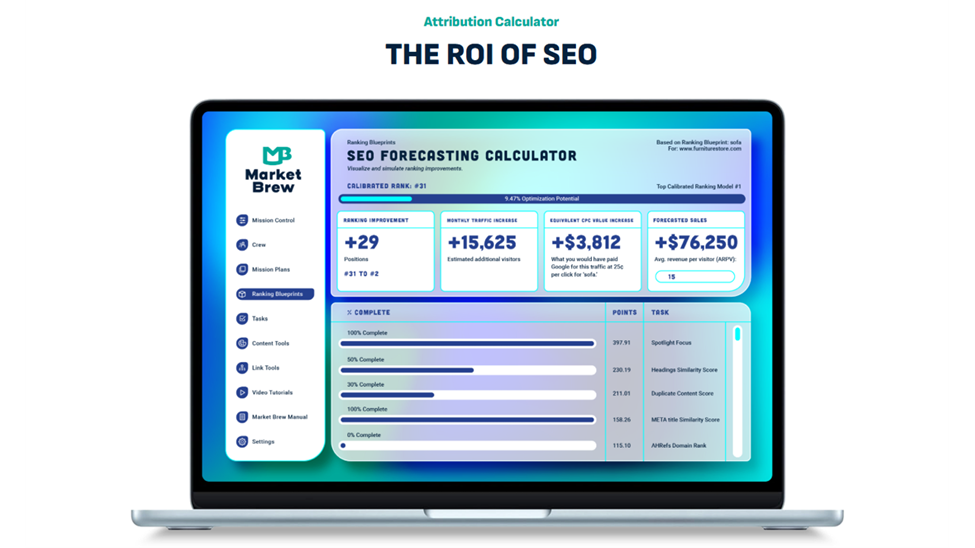
There is never a shortage of projects and initiatives in SEO. The best (worst) part? They're all competing for the same budget, developers, writers, and stakeholder attention.
Many of them may be defensible. But the harder question is which one deserves to happen first.
SEO forecasting helps teams estimate future organic outcomes and compare potential investments before resources are committed. The goal is not simply to predict more traffic. It is to understand the expected impact, effort, uncertainty, and business value attached to a decision.
What Is SEO Forecasting?
SEO forecasting is the process of estimating future organic search outcomes using historical performance, market data, assumptions, modeled changes, or a combination of those inputs.
Forecasts can project future performance or estimate the expected impact of a proposed SEO change.
Those are related, but different, problems.
No forecast can guarantee exactly what will happen. Unfortunately, the SEO crystal ball has not been invented yet.
Competitors change. Search demand moves. Algorithms evolve. Implementation rarely matches a recommendation perfectly.
The purpose of forecasting is to make those unknowns manageable enough to support a better decision.
Two Types of SEO Forecasting
Most SEO forecasting falls into two broad categories.
Performance Forecasting
Performance forecasting estimates where organic performance may be headed based on historical and market data.
It can help teams establish growth expectations, plan budgets, set goals, and estimate the potential business value of organic search.
Change-Impact Forecasting
Change-impact forecasting starts with a decision the organization can make and asks: What might happen if we make this change?
Rather than projecting the current trajectory forward, it compares how expected outcomes could differ under alternative SEO initiatives.
This is particularly useful when several projects are competing for limited capacity.
Creating a Useful SEO Forecast
A useful SEO forecast is built to support a decision, grounding expected outcomes in a credible baseline, transparent assumptions, multiple scenarios, visible uncertainty, and a clear connection to business value.
Start With the Decision, Not the Projection
A useful forecast begins with a clear decision.
There is a meaningful difference between asking: "How much organic growth could we generate next year?" and "Is this sitewide SEO initiative worth the resources it will require?"
The first requires a performance projection. The second requires an investment comparison.
Starting with the decision determines which inputs, assumptions, scenarios, and outputs actually matter.
Without that clarity, forecasting can easily become an impressive-looking chart that does little to change what happens next.
Establish a Useful Baseline
Every forecast needs a current state against which future outcomes can be compared.
The exact baseline depends on the question being asked, but its purpose is consistent: establish the reference point from which projected change will be measured.
For a performance forecast, that may include recent trends, seasonality, current traffic, or existing growth rates.
For change-impact forecasting, the no-change scenario can be especially valuable. It establishes what the organization expects if the proposed initiative never happens.
That gives the forecast a meaningful alternative against which the intervention can be evaluated.
Make the Assumptions Visible
Every SEO forecast contains assumptions.
Historical trends may continue. Search demand may remain within an expected range. A proposed change may be implemented as designed. Projected gains may depend on a certain level of ranking or visibility improvement.
Those assumptions should be visible to the people using the forecast.
A prediction of 25% growth means far less if nobody knows what has to be true for that number to become plausible.
Making assumptions explicit also makes the forecast easier to challenge constructively. Stakeholders can evaluate whether the conditions behind the forecast are reasonable rather than debating the final number in isolation.
Use Scenarios Instead of a Single Answer
SEO forecasts should rarely pretend that one number represents the future.
Performance forecasts can use ranges such as conservative, expected, and aggressive outcomes.
Change-impact forecasts can compare the status quo with one or more possible initiatives.
The goal is to expose a range of plausible outcomes and make the alternatives comparable.
That allows teams to see whether additional upside justifies additional cost, risk, or organizational complexity.
Uncertainty Belongs in the Forecast
Forecasting becomes less useful when uncertainty is hidden behind false precision.
Different initiatives can carry very different levels of confidence even when their expected upside appears similar.
One project may depend on several assumptions about implementation, search demand, and ranking movement. Another may have a more modest expected return but rely on fewer uncertain conditions.
That difference is valuable information.
Uncertainty can be represented through ranges, confidence levels, scenario spreads, or simply a clear explanation of which assumptions have the greatest influence on the outcome.
Forecasting does not remove uncertainty from SEO. It helps teams make better decisions while uncertainty still exists.
For teams interested in the technical side of representing interconnected variables and uncertainty, probabilistic graphical models provide a deeper framework for thinking about those dependencies.
Connect Expected SEO Impact to Business Value
Visibility and traffic are rarely the final business outcome.
Where possible, forecasting should connect expected SEO performance to the value of the opportunity.
This can materially change how an initiative is evaluated.
A large visibility opportunity affecting low-value traffic may be less attractive than a smaller improvement across commercially important pages. Likewise, moderate upside may become compelling when implementation is inexpensive or highly scalable.
Forecasting gives teams a way to evaluate those tradeoffs before the work begins.
Comparing SEO Investments
Imagine an enterprise SEO team has funding for one major initiative this quarter, and three projects have made the shortlist.
- Project A offers meaningful upside but requires substantial content and stakeholder resources.
- Project B has a smaller expected return but can be implemented quickly.
- Project C could affect a much larger portion of the site but carries considerably more development effort and deployment risk.
None is inherently the “best SEO tactic,” but forecasting allows the team to compare them as investments.
Project C may have the largest theoretical upside and still lose priority because it ties up engineering capacity for months. Project B may create less absolute gain but deliver value much sooner. Project A may offer the strongest balance between impact and effort.
Sometimes the larger project still wins.
If it does, the forecast helps show that the juice will be worth the squeeze.
What SEO Forecasting Can (and Cannot) Tell You
SEO forecasting can estimate direction, ranges, relative opportunity, expected impact, and the comparative value of different initiatives.
It cannot guarantee an exact ranking, traffic figure, timeline, or post-deployment result.
A forecast should therefore not be judged by whether it predicts the future perfectly.
Its value is whether it gives the organization a stronger basis for making the decision in front of it.
Where Historical Forecasting Reaches Its Limit
Historical data is one of the most useful inputs in SEO forecasting.
It can reveal trends, seasonality, growth rates, and the trajectory of current performance.
Its limitation appears when the question becomes intervention-specific.
Historical data describes what happened under previous conditions. By itself, it cannot measure the effect of a technical, content, structural, or authority change that has not yet been implemented.
It also cannot establish that a relationship observed in past performance is causal. Two variables may move together without one being responsible for the other, which is why distinguishing correlation from causation matters before turning an observed pattern into a forecasted intervention.
Extending a traffic trend forward can estimate where current performance may be headed if conditions remain relatively similar. Evaluating a new SEO initiative requires another way to estimate how changing those conditions could affect the outcome.
That is where change-impact forecasting becomes particularly valuable.
How Market Brew Approaches Change-Impact Forecasting
Market Brew approaches SEO forecasting through its search engine model.
It creates modeled search environments around the website, competitors, queries, and ranking signals to represent the conditions surrounding current visibility. Our approach grew from patented work on transparent, navigable search modeling designed to make scoring and modeled changes inspectable.
Teams can then evaluate proposed changes within that modeled environment and observe how expected visibility responds.
Those modeled effects become another input in the forecast alongside implementation effort, scale, business importance, and uncertainty.
For enterprise teams evaluating several viable initiatives, that creates a stronger basis for deciding which recommendations deserve to move forward.
Turn an SEO Backlog Into an Investment Roadmap
Enterprise SEO teams rarely lack opportunities to improve.
The challenge is turning those opportunities into a defensible order of operations.
Forecasting provides a common framework for comparing potential initiatives across expected impact, effort, uncertainty, and business value.
Instead of treating every recommendation as another item in the backlog, teams can begin evaluating SEO work as a portfolio of investments.
That is the larger role of SEO forecasting: helping teams choose among possible futures before committing to one.
Test SEO Changes Before You Publish Them
Market Brew helps enterprise SEO teams model proposed changes, compare their expected visibility impact, and determine which opportunities deserve priority before implementation begins.
From ambiguity to actionable insight.
Decode ranking systems, surface leverage points, and deploy with clarity.