
Backlinks can bring authority into a website. But what happens after that authority arrives?
Internal links create pathways between pages, helping determine where link-based authority moves and which parts of the website receive the strongest structural support.
For large websites, that distinction matters a lot. A site may have spent years earning backlinks while still giving relatively little support to its most important product, service, category, or resource pages.
So, to better support the site holistically, teams need to look beyond just “gaining more authority.” They need to understand where the authority they already have is going.
Link Flow helps answer that question.
What Is Link Flow in SEO?
Link equity describes the authority or value that can pass from one webpage to another through a link.
Link Flow describes what happens when those relationships are viewed across an entire website.
External backlinks can introduce link equity into the site. Internal links then create pathways through which that authority moves between pages.
Navigation, editorial links, category structures, resource hubs, breadcrumbs, and other connections all contribute to those pathways.
The resulting allocation of authority across the website is its Link Flow Distribution.
Put simply:
- Link equity is the value that can pass through links.
- Link Flow is how that authority moves through the website.
- Link Flow Distribution is where that authority becomes concentrated.
For a deeper look at the backlinks bringing authority into the website in the first place, see our guide to Link Profile Analysis. This article focuses primarily on what happens after that authority enters the site.
A Website Is a Link Graph
A website is a connected graph of pages and links.
When one page links to another, it creates a pathway between two nodes in that graph. Across hundreds, thousands, or millions of pages, those connections collectively form the site's internal authority network.
This means changing one link can affect more than the two pages directly involved.
A page receiving strong support can pass value into another section of the site. That page can then support additional URLs, creating routes through which authority moves across several levels of the website.
Think of the website like a city.
Backlinks are highways bringing traffic into town. Internal links are the roads that determine where things go once they arrive.
You can have plenty of highways entering the city and still have poor infrastructure if your most important destination is difficult to reach.
The same principle applies to websites.
A highly linked research report, for example, may accumulate significant authority from external sources. If it sits largely isolated from the site's strategic guides, categories, and product pages, much of that authority may remain concentrated around the research rather than helping reinforce other important destinations.
A well-connected internal graph gives that authority somewhere useful to go.
Our guide to link graphs in SEO explores the underlying network concept in greater depth.
What Is Link Flow Distribution?
Link Flow Distribution describes how the available link-based authority within a website is divided among its pages.
Every internal link contributes to that distribution, but those links are rarely created independently.
A navigation link may appear across thousands of pages. A breadcrumb can systematically connect an entire section back toward its parent categories. A resource hub may create pathways into dozens of supporting articles.
Together, those connections create hierarchy.
A major product category or solution page generally has a different strategic role than a login page, privacy policy, archive, or outdated resource.
The internal link graph can reinforce that distinction or blur it.
Link Flow Distribution helps reveal which pages the website is structurally treating as important, regardless of what the SEO strategy says should be important.
What Does an Effective Link Flow Distribution Look Like?
A useful Link Flow Distribution generally creates meaningful separation between a smaller set of strategically important pages and the broader supporting page set.
Visually, this can resemble the descending side of a bell curve.
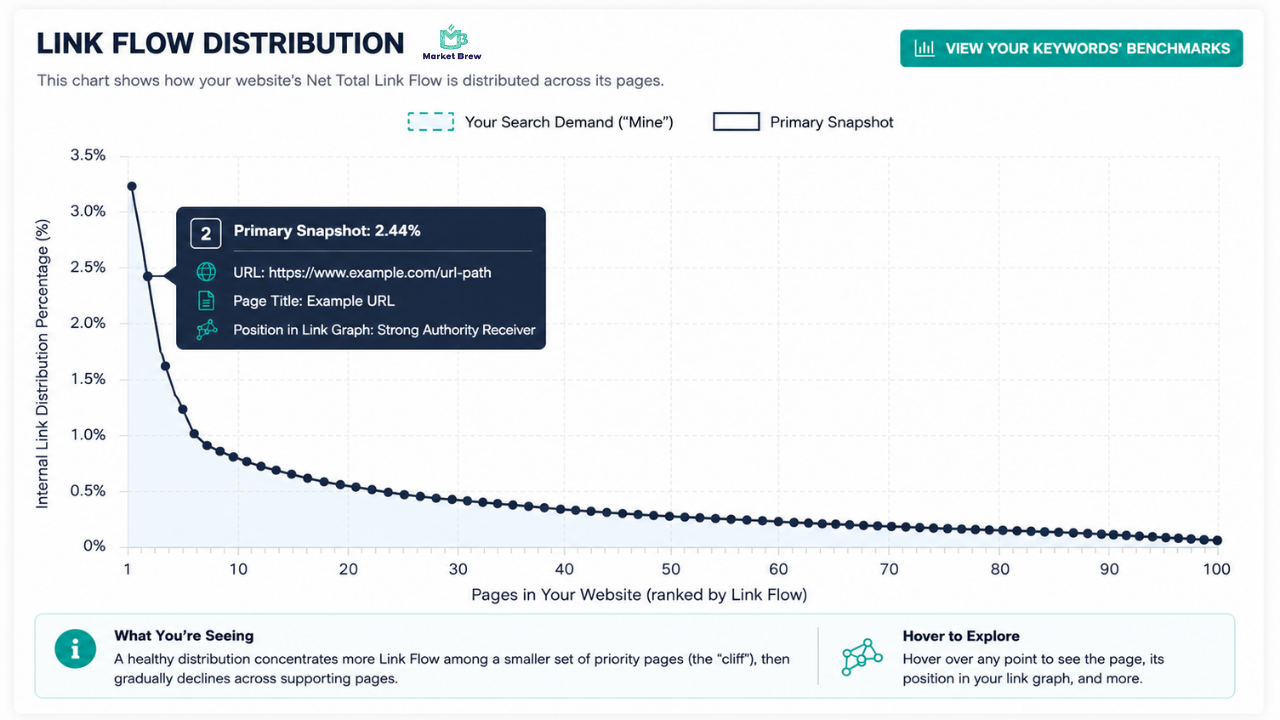
An effective Link Flow Distribution generally concentrates more link-based authority among a smaller set of priority pages before progressively declining across supporting pages.
But it's important to remember there is no universal distribution that every website should reproduce. Site size, incoming authority, architecture, content strategy, and business priorities all affect what the appropriate hierarchy should look like.
What matters is whether the site's internal graph does two things:
- Creates meaningful distinction between pages with different strategic roles.
- Gives the strongest support to the pages that actually matter most.
A distribution can fail on either dimension.
Two Ways Link Flow Distribution Can Break
The Distribution Is Too Flat
A distribution becomes too flat when large numbers of pages receive similar levels of structural reinforcement.
Large, robust site navigation bars can contribute to this.
Mega menus, large footers, repeated sidebars, and template-level links may expose many destinations across substantial portions of the website. Because those elements repeat, one architectural decision can create thousands of internal connections.
There may be perfectly valid usability or business reasons for those links.
The SEO question is what they do to hierarchy.
Imagine putting every building in a city on Main Street. The hospital, stadium, courthouse, office tower, and tiny specialty store are all equally prominent.
Everything may be easy to reach, but very little stands out.
Websites can create the same effect.
If nearly every destination is reinforced like a priority page, the link graph provides less differentiation between the URLs that matter most and the much larger supporting page set.
The Distribution Prioritizes the Wrong Pages
The opposite problem can also occur.
A website may create plenty of hierarchy while directing its strongest structural support toward URLs that no longer represent the organization's priorities.
Sites evolve. Products launch. Categories change. Resource libraries grow. Navigation gets redesigned. Old pages accumulate links over many years.
An older guide may therefore continue receiving substantial Link Flow while a newer strategic solution page sits much farther down the distribution.
The problem here is that the website is unintentionally prioritizing the wrong pages.
The website may say one page is important in a strategy document while its actual internal graph says something entirely different.
That creates a more useful diagnostic question than simply asking whether a page has enough internal links: “Does the website's authority hierarchy match the business and SEO hierarchy we actually want?”
How to Improve Link Flow Distribution
Improving Link Flow begins by understanding the hierarchy the website is currently creating and comparing it with the hierarchy the SEO strategy requires.
Define the Intended Page Hierarchy
Start with the pages that should receive the strongest structural support.
Depending on the website, these may include:
- Major product or category pages
- Core services and solutions
- Strategic commercial landing pages
- Important resource hubs
- High-value informational content
Not every URL needs to occupy the same position.
Utility pages, archives, filters, older resources, and other supporting URLs may serve useful purposes without requiring the same level of internal authority.
Before changing links, determine what the intended hierarchy should actually be.
Compare the Intended Hierarchy With the Current One
Next, examine which pages receive the strongest internal support today.
Look for mismatches such as:
- Priority pages receiving relatively little reinforcement
- Older or lower-priority URLs receiving unusually strong support
- Large groups of pages receiving nearly identical levels of authority
- Strategic sections that are poorly connected to the rest of the site
This comparison turns internal linking from an isolated page-level exercise into a sitewide prioritization problem.
Trace the Pathways Creating the Distribution
Once a mismatch appears, determine why it exists.
Is the authority coming primarily through:
- Main navigation
- Footer links
- Parent categories
- Breadcrumbs
- Resource hubs
- Related-content modules
- Editorial links
- Recurring templates
This distinction matters because adding another internal link is not always the most consequential solution.
If a template appears across 50,000 URLs, its effect on the graph may outweigh dozens of individual editorial links.
Likewise, if a high-authority resource sits disconnected from the strategic parts of the website, there may be an opportunity to create a more natural pathway from that resource into related guides, categories, or commercial pages.
Strengthen the Routes That Support Priority Pages
Once the relevant pathways are understood, teams can begin reshaping them.
Under-supported pages may benefit from stronger connections from:
- Established resources
- Related products or services
- Parent categories
- Topic hubs
- Other pages already occupying strong positions in the graph
Don’t just maximize link counts. Always consider how you can create better, more relevant roads between pages that should reinforce one another.
Our Internal Linking in SEO guide goes deeper into the individual linking practices that create those pathways, while our guide to anchor text explains how the links themselves can also communicate context about the destination.
Reevaluate the Hierarchy as the Website Changes
Link Flow Distribution is not static.
New products, resources, categories, and sections introduce additional destinations for the site's available authority.
A distribution that made sense two years ago may no longer reflect the current strategy.
Large websites therefore need to evaluate Link Flow as the site evolves, particularly after major navigation changes, migrations, redesigns, or content expansion.
A Simple Way to Think About Internal Link Distribution
To make an abstract concept easier to visualize, imagine your website has 100 points of authority available to distribute.
That is not a literal description of how Google calculates PageRank or any other ranking system. Just an analogy.
Suppose Page A earns a significant share because many reputable external websites link to it.
Page A then links to Page B.
Page B connects into Page C.
Across the entire site, thousands of connections create routes through which those hypothetical 100 points become distributed.
Now imagine that Page C is one of your highest-priority product pages.
If the internal graph provides very few strong pathways toward it, the page may receive a relatively small share of the available authority—even though the website as a whole has substantial backlinks.
That is the important distinction: A website can have significant authority and still distribute it poorly.
For large, established brands especially, the next backlink campaign may not always be the first lever worth pulling.
Sometimes the more important question is whether the authority already entering the website is reaching the right destinations.
How Market Brew Measures Link Flow
The process above can be investigated manually.
Teams can inventory priority pages, crawl internal links, analyze recurring templates, inspect backlink destinations, compare page prominence, and trace paths through the site.
The difficulty is scale.
On a large enterprise website, those relationships can involve hundreds of thousands of pages and millions of links. Changing one recurring element can also reshape the graph in ways that are difficult to estimate from individual link counts alone.
Market Brew models those relationships across the full site and represents Link Flow through two related measurements: Net Total Link Flow and Internal Link Distribution Percentage.
Net Total Link Flow
Net Total Link Flow represents the modeled Link Flow remaining after applicable Link Flow penalties are accounted for.
At a high level:
Gross Total Link Flow − Link Flow Penalties = Net Total Link Flow
Gross Total Link Flow represents the modeled Link Flow available before those reductions.
Net Total Link Flow therefore answers the first question: “How much modeled Link Flow remains available?”
Internal Link Distribution Percentage
Internal Link Distribution Percentage answers the second: "Where is that available Link Flow going?"
Return to our simplified 100-point example.
If the website's complete Net Total Link Flow represented 100 available points, Internal Link Distribution Percentage describes the share received by each page.
A page receiving a larger percentage occupies a stronger position within the site's modeled authority hierarchy. A page receiving a very small percentage occupies a weaker one.
Taken across all URLs, those percentages create the site's Link Flow Distribution curve.
This makes the metric more informative than simply counting internal links.
Two pages might each have hundreds of incoming internal links while occupying very different positions in the overall graph depending on where those links originate and how authority reaches those source pages in the first place.
Market Brew makes those relationships visible across the full website rather than requiring teams to reconstruct them one link at a time.
Link Flow is also one part of Market Brew's broader approach to search engine modeling, where authority, content, semantic, structural, and competitive signals can be analyzed as parts of the same connected environment.
See Which Pages Your Website Is Actually Prioritizing
Internal links create hierarchy whether the SEO team intentionally designed one or not.
The challenge is determining whether that hierarchy reflects the pages the organization actually wants to prioritize.
A team can investigate this manually by defining its priority pages, comparing them with the site's strongest internal pathways, tracing where authority enters, and identifying which structures are directing it elsewhere.
Market Brew accelerates that process by modeling Link Flow across the entire website.
Teams can see which pages accumulate the largest shares of modeled authority, identify strategic pages receiving relatively little structural support, and investigate the links and recurring structures contributing to the distribution.
They can then evaluate potential changes to internal links, hubs, navigation, categories, and templates with a much clearer understanding of the hierarchy those decisions create.
Instead of asking only: “Where should we add another internal link?”
SEO teams can ask the more important question: “Is our website directing authority toward the pages that matter most?”
From ambiguity to actionable insight.
Decode ranking systems, surface leverage points, and deploy with clarity.